The Lewis scheme of bonding involves the formation of a covalent bond by the sharing of two electrons between two species. Double and triple covalent bonds have two and three sets of shared electron pairs, whilst lone pairs are valence electron pairs which do not contribute to bonding.
The structures adopted by many compounds can be accounted for by the octet rule.
This states that each atom acquires shares in electrons until its valence shell achieves eight electrons.
This means that the atom has eight electrons in the valence shell, which are enough to fully occupy the s and p orbitals and give the species the closed-shell noble-gas configuration
The Lewis structure or Lewis Representation of a species shows the bonds in a molecule in terms of the shared pairs and lone pairs of electrons in that molecule. Some typical Lewis structures are shown in the table.
| Lewis Representations of common species | |
| Linear Molecules |  |
| Bent Molecules | 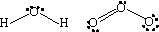 |
| Pyramidal Molecules | |
| Tetrahedral Molecules |  |
The assignment of the Lewis structure allows calculation of the formal charge on an atom and the oxidation state of the atom.
The formal charge, FC, may be calculated using the definition:
FC = Number of valence electrons on the parent atom
– Number of Lone pair electrons
– 0.5 x Number of shared electrons
Thus, in the structure of ozone, O3, above each of the O atoms has a different formal charge.
O(1): FC = 6 – 4 -0.5(4) = 0
O(2): FC = 6 – 2 -0.5(6) = +1
O(3): FC = 6 – 6 -0.5(2) = -1
In general, Lewis structures for a given species may be postulated which have different formal charges on the atoms in the different structures.
The most likely, lowest energy, structure may be predicted as the one with the smallest formal charges on the atoms.